Showing posts with label Rolls etc. Show all posts

30 October 2011

Butter crescents - “Butterhörnchen”


Once again I was unsure about how best to translate the name of these rolls. Literally, a Hörnchen is a small horn or ‘hornlet’, but this just doesn’t sound right. I considered calling them ‘German croissants’, too, but I did not want to risk breaking the European Union's Protected Geographical Status laws and they are also considerably easier to make. I love a good croissant and I am also partial to spending an entire day or even weekend testing complicated and time-consuming recipes. However, the time required to make real croissants is simply incompatible with a full-time job. Whilst these butter crescents are not quite as flaky and light as croissants they are the next best thing. They, too, take a while to make, but most of this time is required for the dough to rise and simply to sit in a warm place until it is ready to bake. They freeze very well and can just be defrosted and reheated in a warm oven for 10-15 minutes – they taste as good as fresh! 

There are a lot of different variants of the butter crescent available throughout Germany and this recipe with simple and buttery yeast dough is a popular version. I like the crescents plain so they can be teamed up with different toppings, but lots of variations are possible. They can be filled with jam, marzipan or with a piece of chocolate. For a savoury version I recommend sprinkling them with coarse sea salt or even with grated cheese. If you are in possession of food-grade caustic soda  for baking Pretzels you can use this to produce ‘Pretzel Crescents’ or ‘Laugenhörnchen’, which have become increasingly popular in Germany in recent years.

The recipe makes 12 crescents:

15 g fresh yeast (or one sachet dried)
1 tsp salt
300 ml warm milk
500 g plain flour
1 tbsp sugar
60g butter

Some melted butter (optional)
Some milk for brushing the crescents before baking

If you are using fresh yeast (recommended), add the yeast and salt to the warm milk, stir until dissolved, and leave to stand for about half an hour. If you use dry yeast just dissolve in the warm milk and salt – no waiting time required.

Mix the milk-yeast mixture with the flour and sugar. Leave to stand for 1-2 hours. Add the butter and knead the dough patiently (about 7 minutes in a food processor, longer by hand) until you have a smooth ball of dough that is not too sticky. Leave to rise for an hour. Stretch and fold the dough and leave to relax for about another hour.

Roll out the dough into a circle about ½ cm thick and leave to relax for a few minutes. Cut the circle into 12 slices like a pie and brush with the melted butter or top with topping, if using. Roll up into crescent shapes. Leave to rise for another 20 minutes or so then brush with some milk and bake at 220 degrees for 25-30 minutes or until they are as brown as you would like them to be.


1 October 2011

Swabian Poor Souls – ‘Schwäbische Seelen’


There are several theories regarding the origin of this bread’s strange name: Seelen, translated as poor souls. It appears to be of a religious nature and linked to All Souls’ Day, a commemoration day met on 2nd November in the Catholic Church calendar. In the region of Swabia food, including Seelen bread, was given as a symbolic offering tothe  poor souls in purgatory, because congregations believed that this would bring them a rich harvest in the following year.

However, to be honest it is not the religious connection that interests me, but the taste and specific texture of this lovely bread. Seelen are large, savoury bread rolls sprinkled with caraway seeds and coarse sea salt.  On the inside they are particularly fluffy and moist owing to the use of very soft dough and spelt flour instead of wheat. In the Stuttgart region Seelen are often eaten for breakfast fresh from the bakery. Another popular variation is to eat them as hot sandwiches filled with ham and cheese. Personally, I would describe this bread as the Swabian equivalent to the baguette or ciabatta. I like serving Seelen with vegetable stew or soup especially in the autumn and winter.

This recipe makes about 6 large Seelen

500g white spelt flour
20g fresh yeast (or one sachet dry)
300 ml warm water
2 tsp salt

For sprinkling: caraway seeds and coarse sea salt

Dissolve the yeast in the warm water and knead all ingredients for about 10 minutes to get soft and fairly sticky dough. Leave to rise in a warm place for about 60 minutes. After 20 minutes and 40 minutes of rising knead the dough again briefly with wet hands. 

When the dough has risen turn it out onto a lightly floured wooden board. With wet hands shape it into a square of about 20 cm. Use a wet knife to cut the dough into six strips. Wet the hands again and transfer the strips onto a baking sheet lined with baking paper. Don’t worry if the Seelen at this point look like a sticky mess, this is quite intentional and they will look rustic once baked.  The sticky dough gives the Seelen their distinctive, chewy texture and open crumb. Cover with a clean dish towel and leave to rise for another 20 minutes.

Preheat the oven to about 240 degrees and place a bowl of water on the bottom shelf. 

When the Seelen are ready to go into the oven wet them again with your hands and sprinkle with caraway seeds and coarse sea salt. Bake for about 20 minutes or until golden brown.

10 September 2011

Pretzels - 'Laugenbrezel'


For those who know Germany (and its baking landscape) my first recipe clearly gives away where I grew up. The Laugenbrezel – a savoury shape baked from yeast dough and with a distinctive brown and chewy crust – can be found mainly in the south of Germany. The best brezels, even if I say so myself, come from the south-west, from Baden-Württemberg (and not from Bavaria!) and particularly from the Stuttgart region. Legend has it that the Laugenbrezel was invented by a baker from Bad Urach, a small town not too far from Stuttgart. Having committed a crime he was sentenced to death by hanging. However, as this was the baker’s first offence the local monarch agreed to give him a last chance: if he succeeded in baking a cake through which the sun could shine three times his life would be spared. The baker went to work and the brezel was the result of his labour.

I love brezels and (apart from my parents) they are what I miss most when I remember Germany. There is only one small complication, which has previously held me back from making my own and homemade version: the distinctive brown and chewy crust of a real brezel can only be achieved properly if it is dunked in a 4% caustic soda solution before baking. Some say that boiling some baking soda in water brings similar results... But this hasn’t made me happy. So finally, on my last trip to Germany, I acquired caustic soda solution in a pharmacy and successfully got the odd-looking bottle covered in hazard signs through Eurostar security... I have not tried to buy food-grade caustic soda in the UK. You might be able to get it from a friendly pharmacist, but I am fairly sure it can also be bought online. You only have to be persistent. It is definitely worth it.


Edit (4th March 2012). A few weeks ago I tried baking the Brezels with a baking soda solution, just because it is so difficult to get the 'proper' caustic soda outside of Swabia. The texture and flavour is not quite the same and they are not quite as shiny, but the result was not too bad. It is certainly better than no Brezels at all! Unlike the caustic soda solution, which is applied cold (indeed, it would be dangerous to heat this up), the baking soda is used with boiling water. Boil 3 tablespoons of baking soda in 2 litres of water for about 10 minutes. Then boil each raw Brezel in this solution for about 20 seconds and leave to drain. Sprinkle with coarse sea salt and bake as below.


This recipe makes about 16-20 medium-sized brezels:

1 kg plain flour (you can also use spelt flour or a mix of both)
35g fresh yeast (or 2 sachets dry)
A pinch of sugar
500 ml lukewarm milk or water or a mix of both (I used half milk, half water)
75 g butter
2 teaspoons salt
coarse sea salt for sprinkling

4% caustic soda solution (about 300 ml)

Dissolve the yeast in the warm liquid and knead all ingredients until you have a firm and relatively dry dough. Leave this to rise in a covered bowl until it has doubled in size (30 minutes to 2 hours).

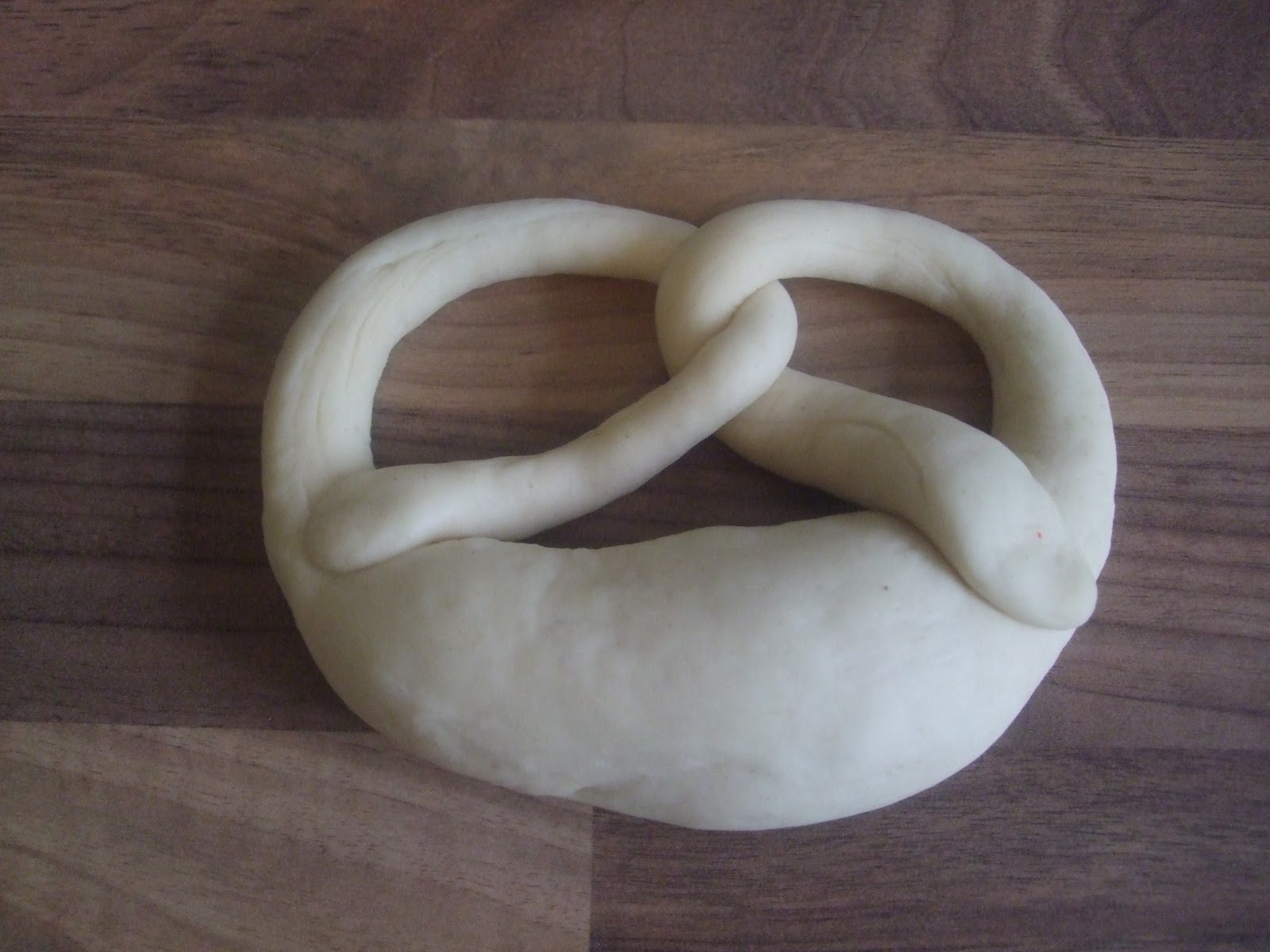
Divide the dough into 16-20 pieces and roll each piece into a strip around 50 cm long. The centre of the strip should be thicker and the ends should be thin. Form each strip into a brezel shape and leave to rise for a few minutes on a baking sheet covered in baking paper (other shapes, such as oblong rolls, plaits or knots are also possible and typical for this kind of bread. These are also quicker to make).


In order to make the brezels’ bath in the caustic soda solution easier it is best to freeze the unbaked brezels for a few minutes (this makes them easier to handle). Put the caustic soda solution into a large enough plastic food container with a tight-fitting lid. Bathe each brezel in this solution for about 30 seconds (turning once). Make sure to wear rubber gloves and maybe goggles, because ‘unbaked’ the solution should not get in contact with the skin or eyes. I also use metal spoons to dunk and turn the brezels and to retrieve them from the caustic soda. The rest of the solution can be kept with a firm lid on until the next time. Just make sure you label it well and keep it out of children’s reach.


Slit the thick part of the brezel (its ‘belly’) with a sharp knife or razor blade so it can rise and will not split randomly on the sides. Sprinkle with coarse sea salt and bake in the oven at 200 degrees for about 20 minutes (or until the kitchen smells fantastic and the brezels have their typical, dark brown colour).

Enjoy them warm and with some cold, salted butter. They are great for breakfast, lunch, afternoon tea, dinner and as a snack :)

PS: They really should be eaten on the same day, because they go hard quickly. They can be frozen and reheated in the oven, but best results can be achieved if you freeze the brezels before baking and then dunk them in the soda solution whilst still frozen and bake them fresh.